Showing posts with label pet photography tips. Show all posts

Friday, October 14, 2011

Investments in business...

I've just been thinking about the whole rationale for why you invest in marketing and publicity and...well, anything related to your business. Hypothetically, you pay for things because they're SUPPOSED to strengthen your business, right?

Of course, this is no exact science, and that is PRECISELY what marketers and publicists and people who sell you advertising count on to keep their own businesses afloat.

For instance, years ago, when I published two children's picture books through Snowbound Press, I invested $12,000 on a publicist. He came highly recommended. He was very, very nice. And my good friend Lydia also spent a similar amount on him to promote HER children's book.

Unfortunately, publicists are not typically paid for productivity. They are paid up front, for their hypothetical connections (which may often be imaginary or inferior to your own connections, to be honest with you).

Nice and highly recommended though Adam was (and I don't think I'm letting the cat too far out of the bag with just a first name there), he GOT FEWER PRESS REVIEWS FOR MY BROTHER'S BOOK THAN I DID FOR MY BOOK WHEN I WAS HANDLING PUBLICITY OUT OF MY DUSTY, SPIDER-INFESTED BASEMENT ON AN UNPAID BASIS.

AND THIS WAS AT A TIME WHEN MY BROTHER WAS HEAD OF STORY ON A MAJOR DREAMWORKS ANIMATION RELEASE. Really. His name on the credits actually showed up BEFORE the movie. And they were in letters LARGE ENOUGH TO READ when you freeze the DVD. It was a big deal!

Whereas, when my book came out, I was famous for NOTHING other than a doctoral dissertation that was so esoteric even I have trouble remembering what it was about, and a bunch of research reports on standardized test validity and assessment systems that nobody bothered to read (OBVIOUSLY, or this No Child Left Behind garbage would not have been such a complete and utter flustercuck).

And I still got loads more press, awards, and sales for my book than the $12,000 guy did for my famous brother's book.

So.

Not a good business investment, that.

Of course, times change. Businesses change. And so what you invest in will change as well.

Now, with my new business, I am VERY happy, because I found something that really works.

The photo is representative of part of my job--getting good reference photos for the portraits. To a large extent, the quality of an animal's portrait is dependent on the quality of the photograph I base it on.

And I have been plagued with photography situations this past week involving squinty cats, bad light, an unfamiliar camera, dogs who WILL NOT PERK THEIR EARS UP, NO MATTER WHAT, and all sorts of twitchy animals who WILL JUST NOT LOOK AT ME BECAUSE I HAVE A CAMERA IN MY HAND.

But I found the RIGHT INVESTMENT TODAY!

Squeaky rubber chicken.

BEST. BUSINESS. INVESTMENT. EVER.

Happy Friday!


Thursday, August 11, 2011

Pet Photos 101: Angles, focus, personality...

This should wrap up the photo advice section of the blog. Now you should have lighting issues under your belt, as well as an animal who’s not trying to run to the broom closet every time you pull out the camera. So here are a few more suggestions for taking photos of your pet.

Angle of portrait:

I like to take photos of animals on their own level. Sometimes shots of animals looking up at you are WONDERFUL -- my most recent portrait of Gracie the Weimeraner is done from an up-angle. You can see it at https://www.facebook.com/photo.php?fbid=240991695933716&set=a.199546436744909.48069.199002330132653&type=1&theater. But, unless you WANT the portrait of your animal to be looking up at you, don’t take a photo of them from that angle. Full body portraits, in particular, tend to be more effective when shot at ground level.

So get ready to sit on the grass or lie on the ground. I love this photo I took of one of the MaxFund Shelter cats. And I was lying on the floor (thankfully, it was clean) at the time! So prepare to look foolish! (It helps that I am toddling off into crone-hood and have long since abandoned any pretense of caring what anybody thinks about me. So if you are relatively young and status-conscious, please try to dump that, at least temporarily, and roll around on the ground a little bit!)

Sometimes I put small pets up on fences or shelves—so I can get a low-angle shot. If you know any Chihuahuas, for instance, you KNOW that probably the most personality-appropriate angle you can get of your Chihuahua is by shooting UP at his chin as if you are some character actor in a 50’s film and he’s the 50-Foot Woman getting ready to stomp on you. Because Chihuahuas are absolutely the BIGGEST dogs I know, personality-wise. They have NO idea that their bodies are relatively tiny. And I like the camera angle to SHOW that attitude sometimes!

Also, if your pet absolutely will NOT hold still, you can have someone hold him (if he is small enough for that). It’s easy for me to crop out hands and arms and edit out other restraints, as long as his body’s not in an extremely odd position and as long as his important markings or contours are not hidden.

Focus on the face:

It’s all about capturing the animal’s soul in paint, for me, and that’s best expressed in his or her face—especially his eyes. So take plenty of photographs that are zoomed in on your pet’s face. Make sure they’re also in sharp focus. These don’t have to be right from the front—you can also take some three-quarter angle views from the front (which is also slightly to one side or the other).

Capturing personality:

Some of this is in the face and the expression, but a lot here depends on keeping your pet as comfortable as possible. As mentioned a few days ago, some animals are incredibly camera-shy and a few days of Snausage treats and flash-free photos are not enough to change that!

So…it’s good to have a helper. Someone with treats or toys who will hold them up and distract your pet from the camera.

Again, be ready to be silly. It’s helpful to know how to make as MANY WEIRD noises as humanly possible (clicks, wolf-whistles, kissy sounds, etc.) to get your pet to attend to you and perk his ears up.

Try to capture the most characteristic expression and pose of your pet. That’s what I want you to have in your portrait. So if your pet is generally happy, try to catch him doing his version of a smile. You might have to trick him into playing with a toy or chasing a ball to get that kind of expression. So do that!

The photograph is absolutely key to getting that expression translated into a painted portrait. We can talk about your pet’s personality a lot, but without seeing it, I will have a REALLY hard time painting it!

Happy picture-taking!

Monday, August 8, 2011

Pet photos 101: Lighting, yadda, yadda, yadda


So, hopefully at this point, you have spent the whole weekend with your pet, your flash-free camera and a lot of treats. And your animal is actually starting to look forward to the camera showing up!

(And we both know I'm probably talking about your dog; cats are either camera-hogs or, if they're camera-shy, TOO stubborn to change their ways after a mere pathetic weekend of treats. There's a reason Pavlov worked with DOGS.)

If not, there's always the stealth approach, which I also favor; using auto-focus and whipping the camera out when your pet is least expecting it. Do that enough and eventually you'll get SOMETHING that's usable!

Anyhow, here are some specific tips around lighting that will help with your pet photos, whether they're shot on the fly or not.

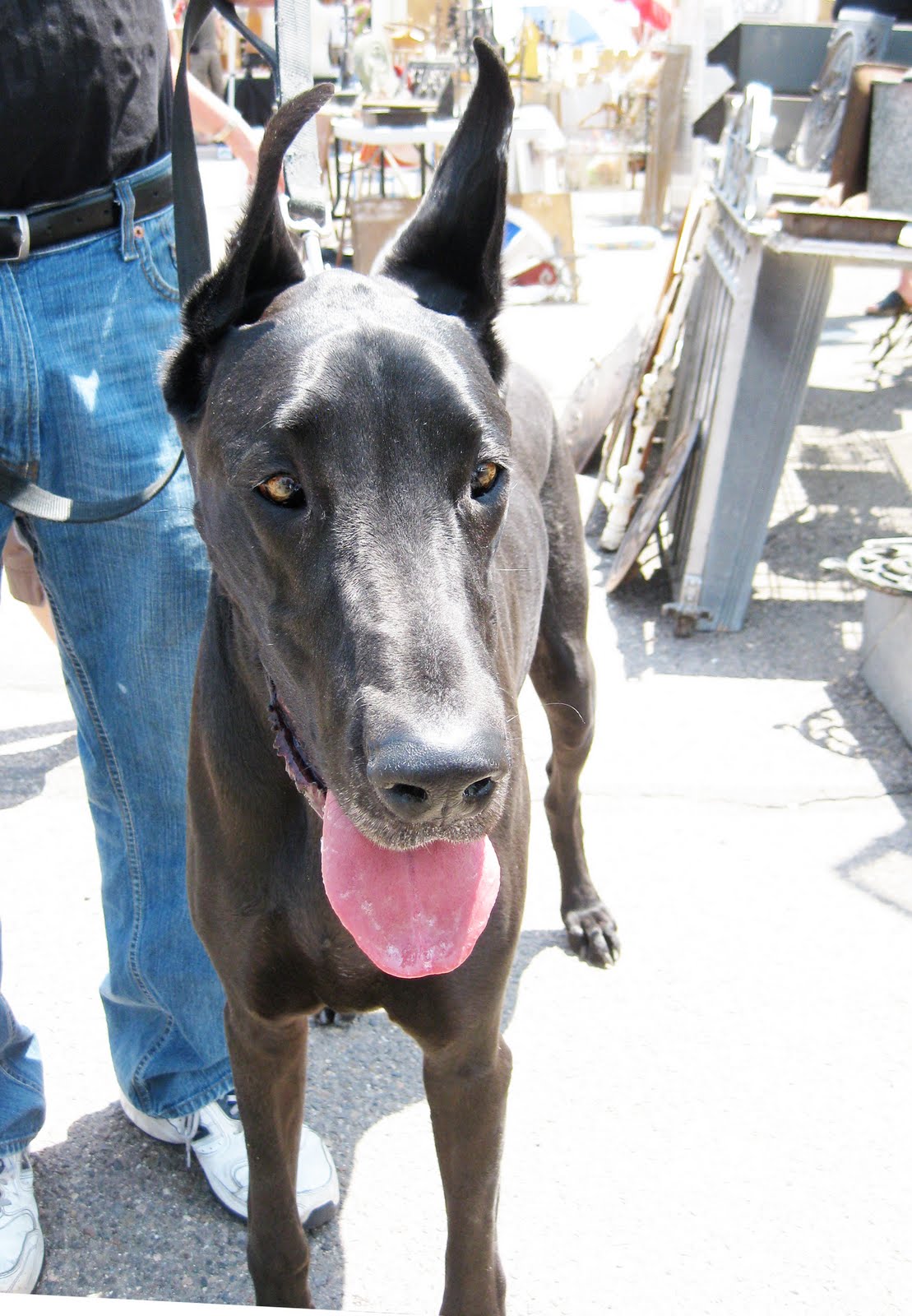
The photos here are a close-up of my painting "Shown Actual Size" and the photo of the Great Dane that I used as its reference.

Because the animal in question here was BLACK, I had to treat it specially. With other animals, using a flash or a bright overhead light has its drawbacks. But for me to adequately see what’s going on with a black animal, bright sunlight or a flash photo can really help.

I photographed this dog on a hot, bright day at around 1 in the afternoon, and, because the light was so intense, I could see planes on the dog’s face that I wouldn’t have been able to see in less bright light.

So that's the case for black animals.

Here are more general tips for lighting your pet photographs:

1--The best possible light for you to use in photographing your pet is outdoor, natural light. This is the case even for indoor pets – but, of course, safety is paramount. So if you are stuck with taking photos inside (say it's freezing out, and you have an iguana, for instance), try to have your pet close to a large window. If possible, have natural light coming in from behind you or to your side as you face your pet.

2--Of course, look out for your SHADOW, or ANY other strange shadows that might fall over your pet in this, or any scenario. I have taken a bunch of photos that I thought were EXCELLENT at the time, only to find that Percy had tree-shadows COVERING his face, making him look like the vein-y Borg queen from that 80’s Star Trek series instead of a happy Golden Retriever!

Now, for everything EXCEPT black or extremely dark animals:

3--The perfect lighting is outdoors, during a bright but overcast day. Direct sunlight can alter natural coloring and increase the contrast so much that the artist can miss key planes in the animal’s face or body. I use photo correction software in my work, so I can adjust the contrast somewhat, but I'm still limited by the original photo.

4--If you can, avoid flash photos – they will, of course, give your pet the notorious demonic red-eye look or the retinal burn. And they can distort your pet’s true coloring. Again, I can correct for this somewhat, but it's better to have something that actually captures what the animal's eyes look like typically -- because that's what you're going to want in a portrait.

So just remember, the more detail you can capture in your photograph, the more I can capture in the painting. If your best photo of Fluffy is of a fuzzy black blob with laserbeam eyes, probably the best portrait I can do will be of a similar quality.

So if it comes down to a choice between finishing a painting for a birthday gift or getting a better photo and missing the birthday, I’d SERIOUSLY suggest you wait for the better photo. You’ll have a better painting. And time is just an arbitrary thing...

Um, that's probably enough for a Monday morning, so I'll hold the rest until the next post, when I’ll be covering angles, focus, and positioning of your pet! Right now I have to dash off and buy some birthday presents for my brother, whose birthday, ARBITRARY THOUGH IT IS, is TOMORROW!

Cripes!

Friday, August 5, 2011

Pet Photos 101: Clearing the first hurdle...

This is Willie. He’s a lovely little well-aged terrier that I met last month. I got one good photo of him, ears up and eyes bright, before he realized what I was doing. And then, once he caught on, EVERY PHOTO I GOT OF HIM LOOKED LIKE THIS.

You just wonder WHAT horrible crime he’s afraid I’m going to find out about.

So I thought that, instead of ranting about Kafka-esque governments or technology for a change, I’d do a few CONSTRUCTIVE blog entries that specifically address the whole pet portrait process…

Which starts with photos of your animal! I, you see, am not one of those crazy masochistic artists who want to paint ONLY FROM LIFE. Technology, when it works, is AWESOME. And photographs HOLD STILL.

So what this means is that, generally speaking, the better the photograph(s) of your pet that I can work from, the better your finished painting will be. So unless you’re going with professionally-done photos, taken with the needs of a portrait especially in mind, here are a few tips for you to take the best possible pet photos you can. All you need is some preparation and patience to get great photos of your pet. Yes, even those pets that are extremely frustrating, like Willie.

Take that terrier of yours who is animated and talkative and who is cuter than a stuffed animal MOST OF THE TIME. But when you pull out the camera, he looks at you as if you are the paparazzi and he has just realized he is not wearing any underwear. Which, of course, he is NOT. But his ears go down, he tries to look away, and you suddenly understand why they call it a “hangdog” expression.

Ah, if only Britney, Lindsay, and Paris had that same sense of propriety that your terrier has…

And I should mention that usually CATS do not have this particular TYPE of photography problem—it’s more germane to dogs.

But anyhow…here is the first trick I’ve learned to deal with those camera-shy pets—but it mainly works for YOU and YOUR pet, since you see him over an extended amount of time:

The first thing you have to remember is that THE DIGITAL CAMERA IS YOUR FRIEND. You are NOT going to run out of film.

So tip #1 is: START TAKING A LOT OF PHOTOS OF YOUR PET—maybe a few (or a dozen) every day. AND TAKE THEM WITH THE FLASH TURNED OFF. AND MAKE SURE YOU HAVE SOME TREATS OR A CHEW TOY OR BALL OF YARN IN YOUR POCKET.

There are a number of reasons for this:

  • It will help your pet get more USED to the idea of being stalked by you, the paparazzi.
  • It will stop the association he has of PHOTOS EQUALLING GETTING BLINDED BY A FLASHBULB. And it will stop him from looking like Earl Hickey every time you take a photo.
  • He might actually start looking forward to getting his picture taken, since he also gets some Snausages or, I don’t know…a mouse, if that’s your version of a pet treat. Or a round of tug-of-war with his favorite sock. Bribes are good, in this scenario. And, by all means, hold them up by the camera to hold his interest while you get the shots.

And of course, the last reason has to do with percentages. The more photos you take of your pet, the more likely you’ll have some really GOOD ones that you can create a great painting from.

As an artist, I don’t typically use multiple photos in designing a composition unless I have multiple SUBJECTS and then I usually HAVE to because if I take a photo of two dogs at the same time, it’s inevitable that when Dog A is looking Cover-Girl fresh, Dog B is licking his butt or wiping a booger out of his eye or doing his best impression of the Elephant Man. I think it’s just a law of nature.

But I don’t, as a rule, PhotoShop ONE image of an animal’s head onto a different photo of his body. It just tends to be wrong, somehow, in an oddly Pet-Cemetary type of way. So I don’t work that way.

But I do work from one primary photo to capture the pose and then use as many other good, clear photos as I can as references so I can get the portrait just right.

More in the next few days about lighting, angles, focus, and ways of capturing your pet’s personality! But for now, just try some of these things with your pet, and you’ll be surprised at how much more receptive he’ll be to getting his picture taken!

Excuse me now, I have to go off to Willie’s. I'm following up a hunch that there are either BODIES buried in his basement or that he’s smuggling diet pills. I don't know...he just looked like he was UP TO SOMETHING...